

01. THE CASE IN ONE PAGE
Executive investment thesis
The world has built digital infrastructures for processes. Mindle ONE is building the integrated infrastructure that makes human performance visible, developable and sustainable across the organisation.
The gap is between what leaders decide, what people do and what customers experience. Mindle ONE closes that gap. Mindle exists on one conviction: people perform at their best not when they become someone else, but when they become fully themselves. Self-realisation is not a soft outcome. It is the mechanism through which personal fulfilment and business performance converge. Mindle exists so people don't have to become someone else to grow — competence, context and character become the same outcome.
Investment thesis
Habegger Consulting AG is transforming decades of practical leadership, sales, service, coaching and organisational development into a scalable human performance ecosystem. The system connects competence architecture, observation on the job, manager led feedback, micro goals, targeted learning, executive dashboards and a person centred lifelong growth journey.
The investment supports a category build. Capital develops the product architecture, the content factory, the enterprise operating model, the market launch and the team capable of scaling the system. Investors are backing the operating intelligence behind Mindle ONE: senior knowhow, methodology, technology, content, data design and execution capability.
|
CHF 5–7M |
Up to CHF 10M |
36 months |
7–10 years |
INITIAL CAPITAL AMBITION | FIVE YEAR EXPANSION CAPACITY | TARGET TO OPERATIONAL BREAK EVEN | LONG TERM VALUE HORIZON |
The first market is Switzerland. The Regio Insubrica provides a natural cross border pilot field, with operations led from Ticino. Controlled enterprise pilots begin from late 2026. Scale follows through Switzerland, Northern Italy, the DACH region and selected European markets.
The primary return engine is enterprise value growth built on recurring revenue, customer expansion, data enabled learning, proprietary content and an increasingly defensible operating system. Dividend capacity begins after sustainable positive cash flow and adequate reserves. Deal structure and ownership terms are defined directly with qualified investors.
Preferred investor profile
This structure is designed for two investor categories: Category Builders entering now at CHF 5–7M, and Category Scalers joining later up to CHF 10M.
02. THE MARKET PAIN
The human performance crisis
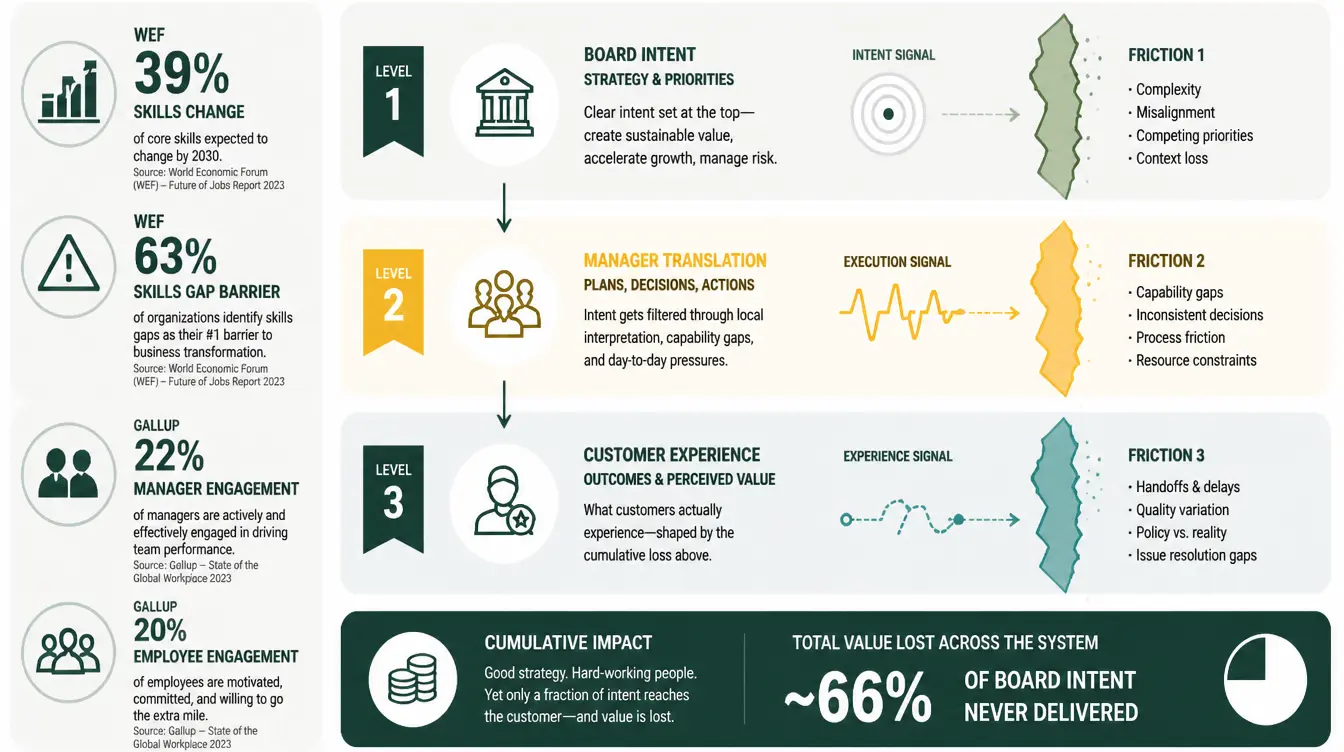
Technology is accelerating. Human execution remains the decisive variable.
Companies invest in ERP, CRM, HRIS, analytics, automation, AI and learning platforms. Their strategic ambition is often clear. The everyday human behaviour that turns ambition into customer value remains difficult to see, coach and sustain. The problem isn't a skills gap — it's a resonance gap. Competence exists, but alignment between person, role and context stays invisible until it fails.
|
Boardroom intent |
Operational reality |
Business consequence |
|
Values and culture are defined |
Teams interpret them through individual habits and local leadership |
Inconsistent customer experience |
|
Training is delivered |
Transfer depends on repetition, feedback and manager quality |
Knowledge with limited behavioural impact |
|
Competencies are assessed |
Criteria often remain broad or judgement based |
Bias, weak comparability and low trust |
|
Targets are set |
Daily micro behaviours receive limited visibility |
Execution gaps emerge late |
|
Employee data is abundant |
Actionable development guidance remains fragmented |
HR reporting grows faster than human capability |
Without shared behavioural anchors, performance quickly becomes interpretation instead of evidence.
The leadership layer carries the pressure. Managers translate strategy, coordinate generations, develop talent, regulate conflict, protect service quality and deliver results. Many reached leadership through technical excellence. Their role now requires coaching, observation, communication and human development at a level that traditional management systems rarely train in real time.
39% | 63% | 22% | 20% |
|
Core skills expected to change by 2030 |
Employers citing skill gaps as a major transformation barrier |
Global manager engagement in 2025 |
Global employee engagement in 2025 |
Sources: WEF Future of Jobs Report 2025 | Gallup State of the Global Workplace 2026
These external indicators describe a broad market shift. Mindle ONE addresses the operational layer: the repeated moments where leadership, competence, service and customer experience become visible.
03. THE WINDOW
Why now
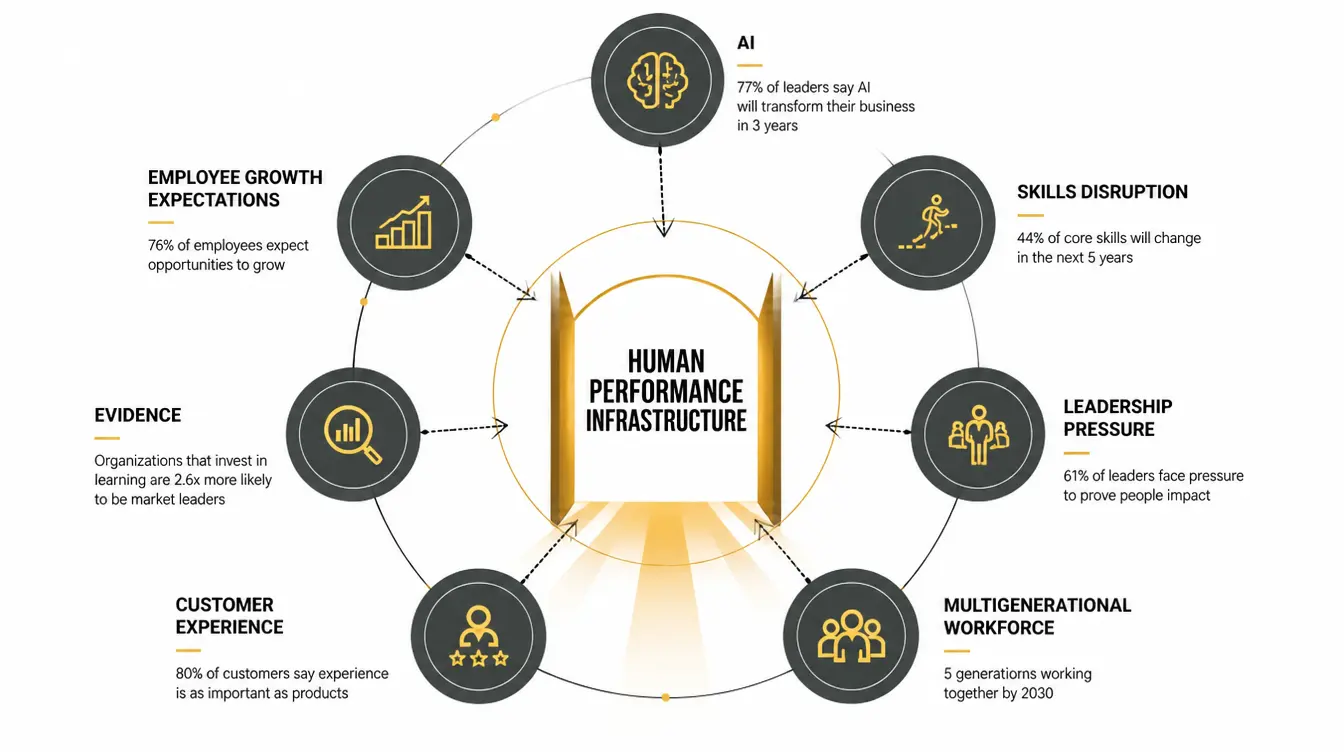
The market has reached the point where human capability must become a managed asset.
|
1 |
AI makes knowledge widely available Access to information becomes easier. Distinctive performance shifts toward judgement, relationship quality, adaptability, trust and execution. |
|
2 |
Skills change faster Employers expect a significant share of core skills to evolve by 2030. Static role profiles lose relevance. |
|
3 |
Managers carry a wider mandate Leadership now includes coaching, emotional regulation, hybrid coordination, change translation and talent development. |
|
4 |
Five generations work together Different expectations, communication preferences and definitions of success intensify the need for shared behavioural standards. |
|
5 |
Customers experience culture directly Service, care, hospitality, sales and leadership quality are lived through individual interactions. |
|
6 |
Evidence enters the boardroom Human capital, quality, risk and transformation decisions increasingly require traceable evidence. |
|
7 |
Employees choose growth environments The strongest employers create visible pathways for learning, trust, autonomy, responsibility and contribution. |
Every company offers jobs. The next generation of companies will offer growth. Mindle ONE makes that growth measurable, scalable and continuous.
This creates a time sensitive opportunity. Enterprise systems already hold employee, process, customer and learning data. Mindle ONE adds the missing human execution layer and connects development directly to daily work.
04. THE CATEGORY GAP
The missing infrastructure
Enterprise technology manages processes, transactions, people records and learning access. Mindle ONE activates the human performance layer that connects them.
|
Enterprise category |
Primary value today |
Human execution opportunity |
|
ERP |
Resources, finance, operations |
Connect process quality to observed human behaviour |
|
CRM |
Customer activity and commercial pipeline |
Connect customer outcomes to relationship competence |
|
HRIS and HCM |
People data, goals, performance processes |
Convert competency intent into continuous development evidence |
|
LMS and LXP |
Content delivery and learning access |
Connect learning to behaviour and transfer on the job |
|
Engagement and survey tools |
Perception and sentiment |
Add observed execution and manager led action |
|
Coaching platforms |
Access to coaches and development conversations |
Embed daily manager coaching and measurable micro progress |
|
Business intelligence |
Data aggregation and reporting |
Add human capability indicators with clear observation anchors |
Mindle ONE complements SAP SuccessFactors, Workday, Salesforce, Odoo, LMS platforms and existing enterprise systems. It gives them an operational human performance layer.
This position is strategically stronger than a replacement story. Large platforms validate the market, hold critical data and provide integration points. Mindle ONE creates value in the space between declared competence and lived execution.
05. THE SYSTEM
Mindle ONE at a glance
Mindle ONE turns strategy into observable behaviour, behaviour into development and development into measurable customer value.
|
Layer |
What happens |
Value created |
|
Strategy |
Leadership priorities, culture, values and customer promise are translated into clear behavioural anchors. |
Shared direction |
|
Competence |
Role based and future oriented competence profiles define what excellence looks and sounds like. |
Clarity and comparability |
|
Observation |
Managers, mentors and qualified observers capture evidence in real work situations. |
Reality becomes visible |
|
Feedback |
Structured conversations convert evidence into reflection, ownership and micro goals. |
Development rhythm |
|
Learning |
AcademyONE assigns targeted content, practice and reinforcement. |
Relevant transfer |
|
Coaching |
Human supervisors and later AI assisted dialogue maintain momentum. |
Continuity and accountability |
|
Measurement |
Dashboards show individual, team, location, region and enterprise progress. |
Executive intelligence |
|
Journey |
The person centred profile connects credentials, achievements and development over time. |
Portable lifelong growth |
One identity. One strategy. One culture. One system.
The system is designed for environments where people create value with people: premium retail, hospitality, gastronomy, healthcare, care services, financial services, customer service centres, public institutions and leadership intensive organisations.
06. ASSESSMENT & ONE MIRROR REPORT
The required entry point
Every successful implementation starts with understanding the current reality.
Your vision. Your culture. The gap in numbers.
ONE Mirror Report
Assessment.ONE is the paid strategic entry engagement for Mindle ONE. It creates immediate value before any platform rollout. The organisation receives a clear mirror of strategic intent, cultural reality, behavioural execution and customer experience. Leadership receives first quick wins and a decision basis for the next step.
|
1 |
Executive alignment Clarify strategy, values, customer promise, transformation priorities and decision criteria. |
|
2 |
Observation design Translate priorities into shared behavioural anchors for selected roles and moments of truth. |
|
3 |
Focused field evidence Observe representative interactions, leadership routines and execution patterns. |
|
4 |
ONE Mirror Report Present gaps, strengths, risks, quick wins, priorities and a recommended rollout architecture. |
|
5 |
Decision workshop Agree whether to proceed, where to pilot, which outcomes to measure and what governance is required. |
|
What the client receives |
What the investor sees |
|
A paid, professional diagnostic with concrete quick wins |
A disciplined customer acquisition mechanism |
|
Value with or without immediate implementation |
Trust and revenue before platform rollout |
|
A quantified baseline |
Evidence for PMF, product configuration and ROI |
|
A tailored roadmap |
Expansion logic from assessment to pilot to enterprise contract |
Commercial rule
Assessment.ONE and the ONE Mirror Report are separate professional services. They are the required starting engagement for enterprise implementations and remain outside the recurring licence price.
07. FROM INTENT TO EVIDENCE
The Mindle ONE operating loop
Development becomes sustainable when it is part of the operating rhythm.
|
1 |
Define Translate strategy, role and customer promise into observable criteria. |
|
2 |
Observe Capture evidence in the real interaction, task, leadership moment or customer journey. |
|
3 |
Reflect Use guided feedback to build awareness and personal ownership. |
|
4 |
Commit Set one clear micro goal linked to the desired behaviour. |
|
5 |
Learn Assign the right micro learning, practice or coaching resource. |
|
6 |
Apply Return to the job and practise within the next relevant moment. |
|
7 |
Measure Compare evidence over time at person, team, site and enterprise level. |
|
8 |
Scale Turn validated patterns into standards, content, certification and rollout. |
See it. Name it. Train it. Live it. Measure it.
The loop creates a continuous feedback architecture. It respects the human relationship while generating evidence. Managers become developers of people. Employees experience progress through small, relevant steps. Boards gain visibility into execution quality.
08. THE INTEGRATED ADVANTAGE
Three category defining innovations
Mindle ONE integrates three advances that the market usually treats as separate worlds.
|
Innovation |
Strategic value |
Why it matters |
|
1. Competence to execution infrastructure |
Future oriented competence architecture connected to observable behaviour, customer experience and business execution. |
Companies can see whether strategy becomes lived excellence. |
|
2. Person centred lifelong growth journey |
A portable personal growth record designed to remain under individual control across roles and employers. |
Human development becomes a lifelong asset. |
|
3. MneMusique |
Original sound based learning experiences that connect message, rhythm, emotion and action. |
Important content becomes easier to recall and reactivate in the moment that matters. |
4. Human Resonance Diagnostics | An emerging diagnostic layer exploring alignment between a person's motivational and physiological profile, their role and the organisational culture. | Could reveal execution gaps that competence-based assessment alone cannot explain. |
Three category defining innovations. One Human Performance Infrastructure.
Resonance is what turns these innovations into one coherent engine: when identity, role and culture align, self-realisation and business execution become the same outcome. The value lies in integration. Competence architecture supplies the language. Observation supplies evidence. The person centred journey supplies continuity. MneMusique supplies memorable reinforcement. The platform, Academy, managers and data model turn these elements into an operating system.
The missing variable behind execution is Human Resonance: the quality of alignment between a person, the people around them and the context in which they work. It explains why the same person can flourish in one environment and fade in another. Eight resonance layers are emerging from Mindle's research foundation: personal, role, relational, leadership, team, cultural, strategic and context resonance. In practice the principle stays simple: the right person, in the right role, with the right leadership and in the right context, becomes more than the sum of their skills..
09. INNOVATION ONE
Competence to execution infrastructure
Mindle ONE connects the competence model of the future with the behaviour experienced today by customers, guests, patients, teams and partners.
The competence architecture begins with role, strategy and context. It includes current operational capabilities and the human capabilities expected to gain importance toward 2030: adaptability, analytical thinking, creative thinking, resilience, leadership, social influence, empathy, self awareness, technological literacy and lifelong learning.
Each competence becomes measurable through anchored evidence. The question moves from a broad judgement such as “Is this person customer oriented?” to specific moments that can be observed, heard and discussed. The same anchors support training, coaching, quality development, career decisions and executive reporting.
|
Level |
Definition |
Example output |
|
1. Competence families |
Personal, social, professional, methodological and fine human capabilities. |
Enterprise competence map |
|
2. Competences |
The capabilities relevant to a role, strategy and future context. |
Role profile and priority weights |
|
3. Excellence dimensions |
Observable dimensions linked to customer and employee experience. |
Leadership, service, sales, care or hospitality dimensions |
|
4. Behavioural anchors |
Clear actions, language and interaction qualities that can be seen or heard. |
Observation matrix |
|
5. Evidence |
Repeated observations, self reflection, outcomes and context. |
Development history and confidence level |
|
6. Action |
Micro goals, learning, coaching and certification. |
Targeted growth plan |
|
7. Business link |
Aggregated patterns connected to quality, customer and performance indicators. |
Board level execution intelligence |
The company defines what excellence means. Mindle ONE makes it observable, trainable and measurable.
10. THE GOOGLE MAPS OF HUMAN GROWTH
Human Competence Graph
The Human Competence Graph connects who a person is, what a role requires, what evidence exists and where growth can create the greatest value.
A static competency list describes isolated elements. A graph shows relationships. It connects people, roles, projects, behaviours, goals, learning objects, coaching, observations, credentials and career possibilities. This creates a living map of human capability.
|
Graph node |
Relationship |
Decision enabled |
|
Person |
Current strengths, goals, preferences and evidence |
Personal growth priorities |
|
Role |
Required competences and behavioural anchors |
Readiness and fit |
|
Project |
Capabilities demonstrated in context |
Opportunity and mobility |
|
Observation |
Evidence linked to behaviour, time and situation |
Development confidence |
|
Learning object |
Content linked to a competence and goal |
Precision learning |
|
Coach or manager |
Feedback and development relationship |
Human accountability |
|
Credential |
Verified achievement or certification |
Portable proof |
|
Career path |
Possible next roles and development requirements |
Visible progre |
A map of competencies becomes powerful when it guides the next real decision.
For the individual, the graph turns development into a visible journey. For managers, it clarifies where coaching creates the highest impact. For HR, it improves workforce planning and internal mobility. For the board, it reveals the organisation’s execution capability and development risk.
11. INNOVATION TWO
Personal Growth Vault
Human development becomes a lifelong asset when the person can carry a trusted growth record across roles, organisations and life stages.
The Personal Growth Vault is the person centred home for competencies, goals, learning, evidence, credentials and recognised achievements. It is designed around individual control and portability. Employers and institutions receive access according to clear consent and purpose.
|
Principle |
Design intention |
|
Person centred ownership |
The individual remains the central controller of the personal growth record. |
|
Portability |
Selected records can accompany the person across roles and employers. |
|
Verifiability |
Credentials and achievements can be issued, checked and trusted. |
|
Selective sharing |
The person can share relevant proof for a specific role or opportunity. |
|
Continuity |
Learning and development remain connected over time. |
|
Enterprise boundaries |
Each organisation retains control of its confidential operational data and assessment context. |
|
Privacy engineering |
Storage, verification, consent, retention and access are designed under Swiss and European data protection requirements. |
A blockchain enabled credential layer can support tamper resistant verification. The final architecture is defined during technical discovery, with privacy, performance, enterprise security and user experience as design criteria. The strategic commitment remains stable: the growth journey belongs to the person.
This is not verification for its own sake. It is the infrastructure that lets a person's growth remain truly theirs, portable proof of who they are becoming, not just what they have completed. The same growth record powers four parallel journeys — Career, Leadership, Performance and Board — each drawing on the same competence architecture but surfacing different evidence for different moments: career mobility, leadership readiness, day-to-day performance coaching and board-level governance oversight.
A job ends. A human growth journey continues.
12. INNOVATION THREE
Mindle Music & MneMusique
Mindle Music uses sound as a bridge between rational understanding, emotional involvement and concrete action.
MneMusique is music designed to support memory, integration and practical application of content. Each original sound experience connects concepts, emotion and action, helping people and groups recall what matters and reactivate it in daily life or work.
|
Design element |
Function |
|
Clear message |
Reduces the content to the essential idea. |
|
Memorable key phrase or image |
Creates a simple retrieval cue. |
|
Accessible rhythm or melody |
Provides structure and repeatability. |
|
Emotional anchor |
Makes the content personally meaningful. |
|
Replay |
Supports reinforcement, continuity and spontaneous recall. |
|
Application cue |
Connects the sound experience to a real moment of action. |
|
Use case |
Example |
|
Corporate learning |
Values, customer experience, leadership, behaviour and culture. |
|
Coaching and personal development |
Insights, new inner narratives and change transitions. |
|
Workshops and retreats |
Emotional integration and a memorable closing trace. |
|
Educational journeys |
Summary, recall and reactivation of key concepts. |
Research on musical mnemonics indicates that rhythm, melody and repetition can support recall in selected learning contexts. The effect depends on design, content, familiarity and repetition. Mindle turns this evidence into a disciplined learning format rather than a decorative song.
13. THE BOARD VIEW
Executive intelligence & dashboards
Leaders gain a direct view of how strategy is being lived across roles, sites, regions and customer touch-points.
|
Dashboard level |
Core questions |
|
Individual |
Which strengths are visible? Which goal is active? Is behaviour improving? |
|
Manager |
Where does coaching create the greatest effect? Which commitments require follow up? |
|
Team |
Which capabilities are strong, inconsistent or at risk? |
|
Location |
How does execution compare across branches, departments or shifts? |
|
Region or country |
Where are standards living well? Where does support create leverage? |
|
Board |
Is strategy reaching the customer? Which capability gaps affect growth, quality or risk? |
Dashboards combine trend, context and confidence. They avoid a false sense of precision by distinguishing between observation volume, evidence quality and score development. Aggregation supports governance while access controls protect individual data.
A board can manage human execution when it can see the pattern, the context and the next action.
14. MEASURE IT, THEN SCALE IT
Product market fit
Product market fit will be measured through customer success, adoption, repeatability, economic value and expansion pull.
Mindle ONE enters through a paid assessment, validates the use case through a controlled pilot and expands only when the customer sees operational value. This creates evidence before scale and protects capital discipline.
|
PMF signal |
Management target |
Evidence source |
|
Assessment to pilot conversion |
Above 35% |
Qualified paid assessments |
|
Pilot to recurring licence conversion |
Above 60% |
Signed annual or multi year agreements |
|
90 day manager adoption |
Above 70% of assigned managers |
Active use and completed development loops |
|
Monthly active manager rate |
Above 65% |
Platform activity |
|
Gross revenue retention |
Above 90% |
Renewals |
|
Net revenue retention |
Above 110% |
User, suite and geography expansion |
|
Customer expansion within 18 months |
Above 30% of accounts |
Additional sites, roles or modules |
|
Behavioural outcome |
Visible improvement in selected anchors within 90 to 180 days |
Repeated evidence and customer KPI context |
Status discipline
These figures are management targets for validation. They are not presented as current traction. Current customers, market con
Market conversations and pipeline signals
The following conversations and engagements represent real market interest. They are not signed contracts. Pipeline and signed revenue remain clearly separated at all times.
Mmax — Leadership Academy programme under discussion. Estimated value approximately CHF 70,000 over three years, with Mindle ONE as a subsequent option.
City of Locarno — Leadership and municipal programmes under discussion. Potential volume above CHF 60,000. Not yet contracted.
Raiffeisen Lugano — Interest expressed by a member of the directorate for a dedicated programme for employees.
alPorto — Reference field for Service, Sales and Excellence. Opportunity linked to the availability of Mindle ONE 1.0.
SUPSI — Exploratory contact for possible academic collaboration.
Investor environments — SICTIC, Fondazione AGIRE, technology partners, Business Angels and possible international development actors.
|
1 |
Customer success Does the system solve a meaningful operational problem? |
|
2 |
Adoption Do managers and employees use it within the real flow of work? |
|
3 |
Repeatability Can the entry, configuration, rollout and support model be repeated? |
|
4 |
Economic value Can the customer connect progress to quality, productivity, retention, customer experience or risk? |
|
5 |
Expansion pull Does the customer request additional roles, sites, suites or integrations? |
15. SWISS BEACHHEAD. EUROPEAN SCALE
Market opportunity
Mindle ONE begins with a focused bottom up market model rather than an inflated top down promise.
Switzerland provides an attractive first market: concentrated decision networks, high labour costs, multilingual operations, demanding service standards and a strong need for measurable human capability. Ticino and the Regio Insubrica form a practical cross border pilot region with access to Swiss and Northern Italian organisations.
11'605 | 2.61M | 306,000 | 84.6M |
|
SWISS COMPANIES WITH 50 OR MORE EMPLOYEES |
JOBS IN SWISS MEDIUM AND LARGE ENTERPRISES |
EU MEDIUM AND LARGE ENTERPRISES, 2024 PRELIMINARY |
EMPLOYEES IN EU MEDIUM AND LARGE ENTERPRISES |
|
Market layer |
Definition |
Illustrative annual licence value |
|
Swiss theoretical pool |
All 2.61 million jobs in medium and large enterprises at CHF 20 per user per month. |
About CHF 627M ARR |
|
Near term serviceable focus |
1,000 organisations with an average 250 in scope users at a blended CHF 21 per month. |
About CHF 63M ARR |
|
Five year operating target |
230 customers and 45,000 active licensed users in the base case. |
About CHF 11.6M exit ARR |
|
European expansion field |
306,000 medium and large enterprises with 84.6 million employees. |
Large multi market opportunity, approached through sectors and partners |
The serviceable market is narrowed by sector, role and problem. Priority environments include customer facing, leadership intensive and quality sensitive operations. The expansion sequence builds references, certified supervisors, implementation capability and integration readiness before broad geographic scale.
16. RECURRING REVENUE WITH HIGH VALUE SERVICE
Business model
Mindle ONE combines paid diagnosis, recurring licences, setup, content, coaching, certification and enterprise integration.
|
Revenue line |
Commercial logic |
Margin and strategic role |
|
Assessment.ONE and ONE Mirror Report |
Paid entry engagement tailored to complexity and ambition. |
Funds acquisition, creates baseline and reduces implementation risk. |
|
Recurring user licences |
CHF 12, CHF 20 or CHF 30 per user per month, billed annually. |
Core ARR engine. |
|
Setup and configuration |
Tenant, roles, matrix, dashboards, onboarding and governance. |
Professional services and faster time to value. |
|
AcademyONE suites |
Sales and Service, Leadership and future sector suites. |
Content leverage and expansion revenue. |
|
Custom matrices and content |
Organisation specific observation anchors, scenarios and learning objects. |
High value configuration with reusable assets where contractually permitted. |
|
Coaching and supervision |
On the job coaching, calibration and human development support. |
Customer success and outcome quality. |
|
Certification network |
Supervisors, coaches, mentors and implementation partners. |
Scalable delivery and quality control. |
|
Enterprise APIs |
Integration with HRIS, LMS, CRM, ERP, identity and BI systems. |
Enterprise lock in through value, not dependency. |
|
MneMusique production and licensing |
Original sound based learning experiences for internal culture and capability. |
Distinctive content and catalogue value. |
The recurring model grows through users, suites, sites, countries and integrations. Professional services accelerate trust and adoption. Content expands gross margin over time as the catalogue and revenue sharing network mature.
Capital efficiency principle
Each investment phase is linked to a de risking milestone: build, validate, convert, retain, expand and internationalise.
17. SCALABLE WITH EVERY EMPLOYEE
Licensing architecture
|
|
ONE START |
ONE GROW |
ONE ENTERPRISE |
|
Price per user per month |
CHF 12 |
CHF 20 |
CHF 30 |
|
User range |
Min. 20 |
50 to 300 |
300+ |
|
Contract |
Annual. |
Minimum 2 years. |
Minimum 3 years. |
|
Billing |
Annual prepayment. |
Annual prepayment. |
Annual prepayment. |
|
User packs |
10 |
10 |
Enterprise volume. |
|
Setup fee |
from CHF 1'000 |
from CHF 3'000 |
Quoted by complexity. |
|
Initial workshop |
from CHF 2'800 |
from CHF 2'800 |
Enterprise programme. |
|
Observation Matrix |
1 standard incl. |
1 standard incl. |
Custom. |
|
Suite |
Core access. |
One suite: Sales, Service or Leadership. |
Complete suites. |
|
Dashboard |
Core. |
Growth dashboard. |
Manager PLUS and Board view. |
|
Onboarding |
Standard. |
Structured. |
Enterprise. |
|
Project management |
Optional. |
Optional. |
Included. |
|
Support |
Standard. |
Priority. |
Enterprise. |
|
API integration |
No. |
No. |
Exclusive. |
Required first step
Assessment.ONE and the ONE Mirror Report are contracted separately before implementation. Each engagement is individually tailored to the organisation’s size, complexity and strategic ambitions, ensuring the right fit and measurable business impact
The licensing model matches organisational complexity while preserving a clear path to expansion.
The price architecture supports a broad customer spectrum without diluting enterprise value. Start creates a manageable entry for smaller teams. Grow adds a suite and structured development. Enterprise unlocks custom architecture, advanced governance and APIs.
18. FROM TRUST TO ENTERPRISE SCALE
Go to market
The first customers enter through trusted relationships, paid diagnosis and controlled proof of value.
|
1 |
Activate warm enterprise relationships Use the historical credibility of Habegger Consulting AG and selected senior introductions. |
|
2 |
Sell Assessment.ONE Create a paid baseline, quick wins and a board level decision basis. |
|
3 |
Design a focused pilot Select one function, location or customer journey with clear anchors and outcomes. |
|
4 |
Prove adoption and progress Measure manager use, behaviour change, customer relevance and operational value. |
|
5 |
Convert to recurring licence Move from pilot to START, GROW or ENTERPRISE with annual prepayment. |
|
6 |
Expand inside the account Add users, locations, suites, countries, coaching and dashboards. |
|
7 |
Integrate enterprise systems Connect identity, HRIS, LMS, CRM, ERP and BI through API architecture. |
|
8 |
Scale through certification and partners Build a controlled delivery network with calibration and audit standards. |
|
Channel |
Role in the model |
|
Founder led enterprise sales |
Opens senior conversations and translates business pain into a strategic use case. |
|
Business Unit Mindle.ONE |
Owns pipeline, implementation, customer success and scale. |
|
Historical client network |
Creates trust, references and sector access. |
|
Strategic partners |
Provide technology, research, market reach and integration capability. |
|
Certified supervisors and coaches |
Extend delivery while protecting the Mindle standard. |
|
Thought leadership and events |
Build the Human Performance Infrastructure category. |
|
Paid campaigns |
Support qualified demand after message and conversion validation. |
|
Fundraising and community channels |
Can support later content, movement and ecosystem expansion alongside lead capital. |
Pipeline governance
The live pipeline remains an external dynamic module. It can be updated without changing the Investor HUB master. Signed revenue, qualified opportunities and strategic conversations remain clearly separated.
19. COMPLEMENTARY. DIFFERENTIATED. DIFFICULT TO REPLICATE.
Competitive position
Mindle ONE occupies the operational space between systems of record, learning platforms, surveys and coaching services.
|
Category |
Centre of gravity |
How Mindle ONE connects |
|
SAP SuccessFactors, Workday and HRIS |
People records, goals, performance and talent processes |
Adds continuous evidence, behavioural anchors and execution development. |
|
Cornerstone, Docebo, Degreed and LMS or LXP |
Learning content, pathways and access |
Connects content to observed need, micro goals and transfer on the job. |
|
Qualtrics, Culture Amp and engagement tools |
Perception, sentiment and experience data |
Adds manager action, observed behaviour and development evidence. |
|
BetterUp, CoachHub and coaching platforms |
Access to coaching and development conversations |
Adds an enterprise competence architecture, manager led loops and operational dashboards. |
|
CRM, ERP and BI |
Customer, process and performance data |
Connects human behaviour to business context. |
|
Mindle ONE |
Human execution infrastructure |
Orchestrates competence, evidence, development, learning, coaching and board visibility. |
SuccessFactors manages people processes. Mindle ONE develops the human capabilities that make those processes succeed.
The competitive story is category creation through integration. Individual components can be copied. The full operating system requires methodology, observation design, content, manager practice, data relationships, customer trust, certification and implementation capability.
20. AUTONOMOUS. API FIRST. ENTERPRISE READY
Technology architecture
The platform is designed
|
Architecture principle |
Business meaning |
|
Independent core |
The platform remains operational as ERP, LMS, CRM or HRIS choices evolve. |
|
API first |
Every integration is documented, secure, versioned and revocable. |
|
Mobile first |
Observation, feedback, micro goals and learning are available within the real flow of work. |
|
Multi tenant enterprise |
Each customer environment is separated, configurable and governed. |
|
Role based access |
Boards, HR, managers, coaches and employees receive relevant views and permissions. |
|
Security by design |
Identity, encryption, audit, consent and data minimisation are designed from the beginning. |
|
Event and evidence model |
Every observation, goal, learning object and credential can be linked through a consistent data structure. |
|
Scalable analytics |
Individual evidence can aggregate to team, location, region and enterprise patterns. |
|
Integration ready |
Enterprise APIs connect identity, HRIS, LMS, CRM, ERP, BI and approved credential services. |
|
AI ready with human governance |
AI assistance supports reflection and navigation while human accountability remains central. |
As an independent, modular infrastructure that can integrate with existing enterprise systems and scale beyond the current ERP or LMS environment.
The AI Mentor enters in a later product stage as an assisted dialogue function. It can ask reflective questions, provide reminders, summarise progress and suggest relevant content. Human managers, mentors, coaches and supervisors remain responsible for context, judgement and relationship quality.
21. PERSON CENTRED. ENTERPRISE CONTROLLED.
Trust, privacy and governance
Mindle ONE earns trust by making purpose, access, evidence and responsibility visible.
|
Governance domain |
Core control |
|
Purpose |
Every data point has a defined development or governance purpose. |
|
Consent and access |
Users see who can access which information and why. |
|
Data minimisation |
Collect the evidence needed for development and decision making. |
|
Role separation |
Boards, HR, managers, coaches and employees receive distinct access. |
|
Evidence quality |
Observation volume, recency, context and confidence are transparent. |
|
Calibration |
Observers and supervisors use shared anchors and regular quality checks. |
|
Retention |
Data retention follows purpose, contract and applicable law. |
|
Audit trail |
Changes, access and relevant decisions remain traceable. |
|
Portable credentials |
Verified achievements can be shared by the person through trusted formats. |
|
Enterprise confidentiality |
Organisation specific matrices, results and operational context remain protected. |
The technical and legal design follows the Swiss Federal Act on Data Protection, applicable European requirements and enterprise security expectations. Verifiable credential standards provide a mature direction for issuers, holders and verifiers. The final implementation is selected during architecture discovery and legal review.
Trust principle
Human performance data requires stronger governance than ordinary learning data. Mindle ONE treats transparency, dignity, context and development purpose as product requirements.
22. THE SYSTEM BEHIND THE SOFTWARE
The moat
The defensibility of Mindle ONE comes from the integrated operating intelligence required to make the system work in reality.
|
Moat layer |
What compounds over time |
|
Senior operating knowhow |
Decades of experience across sales, service, leadership, HR, coaching, communication and transformation. |
|
Competence architecture |
Role profiles, future skills, behavioural anchors and sector matrices. |
|
Implementation method |
Assessment, Mirror Report, pilot, calibration, rollout and governance. |
|
Human Competence Graph |
Relationships between people, roles, evidence, learning, credentials and careers. |
|
Content factory |
AcademyONE, micro learning, practice, coaching scripts and MneMusique. |
|
Evidence model |
Structured data on observation, progress, adoption and context. |
|
Customer configuration |
Strategic priorities, custom matrices, integrations and operating routines. |
|
Certified network |
Supervisors, coaches, mentors, partners and quality assurance. |
|
Brand and category |
Human Performance Infrastructure as a trusted decision framework. |
|
Learning loop |
Every implementation improves product configuration, content and benchmark insight. |
The software can be built. The operating system must be earned.
This is why the investment is fundamentally an investment in people and capability. Capital transforms senior knowledge into repeatable product architecture, scalable delivery, data relationships, content and market leadership.
23. BUILD. VALIDATE. SCALE. LEAD.
Roadmap 2026 to 2034
The roadmap protects product quality and capital discipline through milestone based expansion.
|
Phase |
Timing |
Product and market milestone |
Capital logic |
|
Foundation |
Q3 to Q4 2026 |
Architecture discovery, core team, Assessment.ONE, first demonstration dashboards, content production engine, first controlled enterprise pilots. |
Initial capital activates build and market proof. |
|
Validation |
2027 |
MVP in operation, paid assessments, repeatable pilots, first recurring licences, PMF measurement, Swiss references. |
Invest behind evidence and adoption. |
|
Scale Switzerland |
2028 |
START, GROW and ENTERPRISE fully operational, Academy suites, manager dashboards, certification, broader Swiss rollout. |
Increase sales, implementation and customer success. |
|
Break even and regional expansion |
2029 |
Operational break even target, Northern Italy and DACH expansion, first enterprise APIs, Personal Growth Vault pilot. |
Shift from build capital to growth capital. |
|
European growth |
2030 to 2031 |
Multi country accounts, partner network, advanced board analytics, AI assisted development, MneMusique catalogue. |
Optional follow on capital up to total CHF 10M. |
|
Category leadership |
2032 to 2034 |
European scale, benchmarks, mature Human Competence Graph, portable credentials and expanding ecosystem. |
Compounding ARR, margin and strategic value. |
24. CAPITAL TO BUILD THE CATEGORY
Investment case
Habegger Consulting AG seeks CHF 5 million to CHF 7 million in initial growth capital, with the capacity to deploy up to CHF 10 million over the first five years for full expansion.
The capital requirement reflects the real cost of building an enterprise grade system and a market category. Technology is one part. The investment also creates the content catalogue, implementation capability, enterprise sales engine, launch campaign, security architecture, data model, certification network and customer success organisation.
CHF 5M | CHF 7M | CHF 10M | 2029 |
|
MINIMUM VIABLE CAPITALISATION |
PREFERRED INITIAL ROUND |
MAXIMUM FIVE YEAR EXPANSION CAPACITY |
BASE CASE BREAK EVEN TARGET |
|
Investment principle |
Meaning |
|
Build for enterprise trust |
Security, multi tenancy, governance, APIs and support are designed at enterprise standard. |
|
Build content at the same speed as technology |
The system requires practical multilingual learning, coaching and reinforcement. |
|
Fund a real launch |
Category creation requires thought leadership, enterprise sales, paid campaigns and events. |
|
Keep implementation human |
Customer success, calibration and coaching protect adoption and outcomes. |
|
Stage capital by milestone |
Follow on deployment is released against product, PMF, recurring revenue and expansion evidence. |
|
Preserve execution focus |
Investors contribute access, credibility and governance while the operating team retains delivery autonomy. |
The capital buys the capability to build a category, not a finished box of software.
Potential capital channels can include a lead investor, strategic corporate investors, family offices and milestone based follow on capital. Fundraising or community channels can later support content and movement expansion. Deal structure remains part of qualified direct conversations.
25. THE CHF 7 MILLION BASE PLAN
Use of funds
The preferred initial round is allocated to the product, content and market capabilities required for a credible enterprise launch.
|
Use |
Amount |
Share |
Outcome |
|
Core platform and product engineering |
CHF 2'100'000 |
30% |
Independent core, mobile and web experience, workflow, analytics, graph, dashboards and product management. |
|
Content factory and Academy production |
CHF 1'400'000 |
20% |
Multilingual suites, micro learning, coaching tools, sector content, MneMusique and production capacity. |
|
Market launch and paid acquisition |
CHF 980'000 |
14% |
Category campaign, thought leadership, events, creative production, digital acquisition and launch ADV. |
|
Enterprise sales and partnerships |
CHF 840'000 |
12% |
Senior sales, strategic partnerships, market development and customer acquisition. |
|
Data, security, compliance and integrations |
CHF 630'000 |
9% |
Privacy engineering, security, identity, audit, API architecture, legal and enterprise readiness. |
|
Customer success, implementation and certification |
CHF 490'000 |
7% |
Assessment delivery, onboarding, calibration, supervisors, support and outcome quality. |
|
Operations, governance and specialist advisors |
CHF 350'000 |
5% |
Finance, people operations, board support, contracts, due diligence and specialist expertise. |
|
Strategic reserve |
CHF 210'000 |
3% |
Contingency, opportunity capture and controlled risk buffer. |
|
Capital stage |
Indicative capacity |
Release logic |
|
Initial foundation and validation |
CHF 5M to CHF 7M |
Architecture, product build, content, launch, first recurring customers and repeatable PMF evidence. |
|
Follow on scale capacity |
Up to a cumulative CHF 10M |
International expansion, enterprise integrations, larger sales capacity, advanced AI and credential infrastructure after milestones. |
26. ILLUSTRATIVE MANAGEMENT CASE
Financial outlook
The model targets operational break even within 36 months of commercial rollout. Value is built through recurring enterprise licences and accelerated by paid assessment, implementation and enterprise leadership development revenue.
Model status
The following figures are management planning assumptions for capital and operating design. They are not guarantees. The revised base case explicitly includes a phased contribution from enterprise Leadership Enablement and separates recurring ARR from recognised annual revenue. The model will be refined through technical discovery, investor due diligence and validated customer acquisition data.
|
Year |
Revenue |
Exit ARR |
Licensed users |
Customers |
Core FTE |
EBITDA |
|
2026 |
0.18M |
0.05M |
0.2K |
2 |
8 |
-0.75M |
|
2027 |
1.10M |
0.60M |
2.5K |
18 |
18 |
-2.12M |
|
2028 |
3.55M |
2.25M |
9K |
55 |
30 |
-1.00M |
|
2029 |
8.10M |
5.55M |
22K |
120 |
45 |
0.62M |
|
2030 |
14.90M |
11.60M |
45K |
230 |
65 |
2.52M |
2031 | 22.0M | 19.5M | 75K | 360 | 85 | 5.0M |
|
2032 |
32.20M |
28.40M |
110K |
510 |
105 |
7.70M |
2033 | 47.0M | 42.0M | 165K | 730 | 132 | 12.0M |
|
2034 |
63.70M |
56.80M |
220K |
950 |
160 |
17.00M |
|
Scenario |
Break even |
Revenue 2030 |
Revenue 2034 |
Operating interpretation |
|
Prudent |
2030 |
9.0M |
34M |
Slower licence conversion, selective programme adoption and later geographic expansion. |
|
Base |
2029 |
14.9M |
63.7M |
Controlled Swiss scale, phased enterprise programmes, regional expansion and growing enterprise accounts. |
|
Accelerated |
2028 |
23M |
108M |
Faster enterprise conversion, higher programme penetration, strategic distribution and earlier multi country accounts. |
The outlook combines recurring licences with paid assessment, setup, integrations, Academy suites, coaching, certification, MneMusique and enterprise Leadership Enablement. Exit ARR is shown separately from recognised annual revenue because enterprise contracts can start during the year and professional services are recognised when delivered. The base case includes a conservative phased share of Leadership Enablement revenue. Stronger programme penetration remains upside in the accelerated scenario
Capital runway note: With CHF 7M initial capital and projected cash consumption of CHF 0.75M (2026), CHF 2.12M (2027) and CHF 1.00M (2028), cumulative burn through break-even in 2029 reaches approximately CHF 3.87M. This leaves a CHF 3.1M buffer within the initial CHF 7M raise, providing runway beyond break-even and into the scale phase. The CHF 10M expansion capacity is activated only after operational milestones are validated..
Leadership Enablement economics
Leader Excellence is delivered to enterprise cohorts of up to 15 people leaders, live via Zoom or on site. The planning model uses average revenue of approximately CHF 38,000 per cohort, including behavioural assessment, collective debriefing, two individual coaching sessions per participant and structured PDF learning materials. Travel and on-site expenses are charged separately.
|
Scale metric |
Management planning assumption |
Financial implication |
|
Eligible leader population |
Approximately 4,500 to 5,500 people leaders per 100,000 employees reached. |
A substantial enterprise capability-building market exists inside the licensed employee base. |
|
Planned programme penetration |
Approximately 210 to 300 cohorts, representing 3,150 to 4,500 participants. |
The range allows for blended delivery, larger groups, excluded roles and partial participation. |
|
Cumulative programme revenue |
Approximately CHF 8.0M to CHF 11.4M per 100,000 employees reached. |
Recognised as implementation and capability-building revenue, separate from ARR. |
|
Contribution margin |
Approximately 20% to 25% after external trainers, live production, franchise commissions and direct delivery costs. |
Cumulative contribution potential of approximately CHF 1.6M to CHF 2.85M. |
|
Break-even effect |
Revenue is generated during customer rollout while recurring licences continue to compound. |
Strengthens cash generation and can move operating break even toward the accelerated case. |
27. VALUE CREATION OVER SEVEN TO TEN YEARS
Investor return logic
The return profile combines long term company value growth with progressive dividend capacity and earlier cash generation from enterprise implementation and leadership development.
|
Return driver |
How value is created |
|
Implementation cash engine |
Paid assessment, setup and Leadership Enablement generate revenue and contribution while recurring ARR compounds. |
|
Recurring revenue |
Annual and multi year licence contracts create predictability and visibility. |
|
Net revenue retention |
Accounts expand through users, sites, suites, countries, dashboards and APIs. |
|
Gross margin progression |
Software, content and recurring licences create the highest long-term leverage. Enterprise Leadership Enablement contributes approximately 20% to 25% after direct delivery costs and accelerates cash generation during rollout. |
|
Strategic data relationships |
The Human Competence Graph and evidence model improve product relevance and switching value. |
|
Category leadership |
A trusted Human Performance Infrastructure brand can command strategic value. |
|
Certified ecosystem |
Partners and supervisors expand capacity without matching every revenue increase with internal headcount. |
|
Dividends |
Distributions begin after sustained positive EBITDA, free cash flow and adequate reserves. The base planning window remains 2029 to 2030 onward. |
|
Strategic liquidity options |
A future secondary, partial buyback, strategic investment or transaction can be considered when scale and governance support it. |
The primary value mechanism during the first years is valuation growth. Leadership Enablement is excluded from ARR, so it strengthens cash generation without inflating the recurring revenue multiple. The board will monitor ARR, growth, retention, gross margin, CAC payback, customer concentration, enterprise adoption, programme contribution and cash generation. An enterprise value framework can apply the market multiple available at the time to the quality and growth of recurring revenue. This master makes no fixed return multiple promise.
Target operational break even within three years. Progressive dividend capacity thereafter. Long term value creation over a seven to ten year horizon.
|
Investor horizon |
Value milestone |
|
0 to 2 years |
Product architecture, PMF evidence, first recurring licences and category credibility. |
|
3 to 5 years |
Operational break even, Swiss scale, regional expansion, enterprise programme contribution and stronger enterprise value. |
|
5 to 7 years |
European growth, dividend capacity and potential partial liquidity options. |
|
7 to 10 years |
Mature recurring revenue platform, strategic partnerships and long term value realisation. |
28. EXECUTION CREDIBILITY
Founder and team
Mindle ONE is a Senior Startup: built from lived market experience, customer reality and the courage to turn decades of knowledge into a scalable system.
|
Role |
Contribution |
|
Stefano Habegger. |
Vision, method, enterprise relationships, product logic, investor dialogue, content and category creation. Professional experience since 1979 across sales, management, marketing, event management, Leadership & HR-Mgmt., broadcast & keynote speaker, C-Level coaching, profiling, business mentalism, transformation and board responsibility. |
|
Belinda Habegger. |
Deep human development. Holistic mindset, energy & health coach. Self leadership, stress & change management management. Game changer. |
|
Riccardo Virga. |
Riccardo works alongside Stefano across Habegger Consulting AG, Mindle and Mindle ONE as his closest executive counterpart. He connects operations, partnerships, organisation and scale, with a clear long-term path into broader corporate leadership. |
Filipe Soares. | Business development, training, consulting and market access in Romandie and French-speaking segments. |
Alexander Gonzalez. | Financial order, accounting, administrative structure and support for operational stabilisation. |
|
Andrea Caglioni. |
IT entrepreneur with experience in building companies, international collaborations and access to technology, business and investor networks. Strengthens the technical-strategic level and the credibility of development governance. |
Tech partner. | For the further development and extension of the Mindle.me platform. |
|
Academy and specialist partners |
Content creation, learning delivery, sound production, coaching and sector expertise through structured revenue sharing. |
Stefano’s differentiator is practical range. He has worked from frontline selling to executive and board responsibility. He has managed teams, purchasing and supplier relationships, marketing, crises, conflict, change and customer transformation. The human factor was repeatedly the difference between a process that existed and a result that lived.
We are asking investors to back our brains, our operating experience and our ability to build the system. The software is the vessel.
Founder scalability is built into the architecture. Business Unit ownership, certified delivery, customer success, content standards, dashboards, partner governance and a repeatable assessment method allow Mindle ONE to grow because the system works, rather than because Stefano is always in the room.
29. GROWTH WITH DISCIPLINE
Risk control
The investment case becomes stronger when the risks are explicit and each one has an operating control.
|
Risk |
Control architecture |
|
Founder dependency |
Business Unit leadership, certified supervisors, partner network, documented method, content standards and governance. |
|
Premature scaling |
Paid assessment, controlled pilots, PMF gates and milestone based capital deployment. |
|
Technical execution |
Architecture discovery, partner shortlist, modular roadmap, security review and risk register. |
|
Market adoption |
Warm access, paid diagnosis, quick wins, customer success metrics and expansion evidence. |
|
Quality drift |
Observer calibration, clear anchors, certification, audit trail, supervision and dashboard confidence indicators. |
|
Data and privacy |
Purpose limitation, role based access, consent, retention, security by design and legal review. |
|
Delivery capacity and margin |
Certified trainers, franchise governance, cohort planning, blended delivery, quality calibration and contribution-margin monitoring against the 20% to 25% planning range. |
|
Content production capacity |
Content factory, editorial standards, partner model, reuse architecture and production planning. |
|
Customer concentration |
Sector diversity, account caps, partner channels and geographic expansion. |
|
Cash pressure |
Capital staging, annual prepayment, setup revenue, reserve, milestone gates and monthly cash governance. |
|
Investor interference |
Clear governance, reserved matters, agreed milestones and operating autonomy. |
|
Claims and reputation |
Evidence register, disciplined wording, separation of targets from current traction and source control. |
Decision discipline
Only signed contracts are recognised as committed revenue. Pipeline and opportunity data remain in a separate dynamic module with dated status, owner, probability and next action.
30. THE LIFELONG HUMAN GROWTH INFRASTRUCTURE
Vision 2040
Mindle ONE begins in the enterprise and grows toward a world where human development remains connected throughout life.
The long term vision is a connected growth ecosystem. A person can understand strengths, develop relevant competencies, receive evidence based coaching, access targeted learning, carry trusted credentials and see new opportunities across changing life stages.
An organisation can translate strategy into daily behaviour, develop managers as human growth multipliers, connect culture to customer experience and manage human capability with the same seriousness applied to finance, operations and technology.
A society can value growth as an asset that travels with the person. Education, work, leadership, reinvention, mentoring and legacy become part of one connected journey.
The success story of 2040 is being written today.
ONE | LIFELONG | MEASURABLE | HUMAN |
| CONNECTED ECOSYSTEM | PERSON CENTRED JOURNEY |
HUMAN EXECUTION |
TECHNOLOGY WITH PURPOSE |
Mindle ONE is designed to become the system behind human performance: visible from the boardroom, useful in the moment of work and meaningful to the person whose growth creates the value.
31. MAINTAIN THE MASTER. UPDATE THE EVIDENCE.
Dynamic modules and source register
The base Investor HUB remains stable. Time sensitive evidence is maintained through separate controlled modules.
|
External dynamic module |
Update rule |
|
Client carousel |
Current and historical approved clients only. Match the Mindle homepage. Update independently from the master. |
|
Pipeline and market pull |
Dated status, owner, next action, probability and indicative value. Separate signed revenue from opportunities. |
|
Sales Deck |
Current commercial offer, implementation detail and sector use cases. |
|
Due diligence data room |
Financial statements, cap table, contracts, technical discovery, legal documents, security roadmap and governance. |
|
Reference cases |
Published only after customer approval and evidence review. |
|
Investor FAQ |
Updated from recurring qualified investor questions. |
Internal source register
|
Source |
Use in this master |
|
Investor pitch remake, 11 to 13 July 2026 |
Strategic sequence, visual direction, category positioning, entry product, Human Competence Graph, dashboards and investment logic. |
|
Business Plan Habegger Mindle 2026 to 2030 v3.2, 1 July 2026 |
Company context, product logic, partners, old financial baseline, risk framework and operating roadmap. |
|
Habegger Consulting AG 2025 income statement |
2024 and 2025 revenue, EBITDA, EBIT and result baseline. |
|
Mindle ONE technical architecture and blueprint |
System architecture, competence layers, observation loop, dashboards and enterprise design. |
|
Mindle ONE pricing decisions, July 2026 |
CHF 12, CHF 20 and CHF 30 licence architecture and Assessment.ONE separation. |
|
Mindle Music and MneMusique author statement, July 2026 |
Definition, use cases, authorship and copyright position. |
|
Mindle current colour palette |
Gold #FBB900, white, petrol #385652, warm gold #FFE3AA, grey #6C757D, black and deep petrol #1D2F2B. |
|
Leader Excellence enterprise programme model, July 2026 |
Cohort economics, enterprise inhouse delivery, behavioural assessment, individual coaching and the 20% to 25% contribution-margin planning range. |
External evidence register
|
Organisation |
Source |
Evidence used |
Link |
|
World Economic Forum |
The Future of Jobs Report 2025 |
Employers expect 39% of key skills to change by 2030. 63% cite skill gaps as a major barrier to transformation. |
|
|
Gallup |
State of the Global Workplace 2026 |
Global employee engagement was 20% in 2025. Manager engagement was 22% after a five point decline. |
|
|
Swiss Federal Statistical Office |
Structural Business Statistics STATENT 2023 |
Switzerland had 9,791 medium and 1,814 large commercial enterprises, employing 978,425 and 1,633,276 people respectively. |
|
|
Eurostat |
Structural Business Statistics by enterprise size |
EU medium and large enterprise counts and employment used for European scale context. |
|
|
W3C |
Verifiable Credentials Data Model v2.0 |
Issuer, holder and verifier model. Tamper resistance, privacy and security considerations. |
|
|
Frontiers in Education |
Musical Mnemonics Enhance Verbal Memory in Typically Developing Children, 2018 |
Randomised study supporting the potential of rhythmic melodic templates for verbal recall in a defined context. |
|
|
Frontiers in Human Neuroscience |
Music Mnemonics Aid Verbal Memory and Induce Learning Related Brain Plasticity, 2014 |
Evidence that musical templates can support verbal learning in a defined clinical context. |
|
Legal and financial notice
This document is prepared for discussion with qualified investors and strategic partners. It is not an offer, prospectus or promise of return. Financial scenarios are management assumptions and require due diligence, legal review and board approval.
Imagine a world where human growth becomes a lifelong asset.
Mindle ONE